A personal use case revealed a truth about organisational readiness for agentic access.
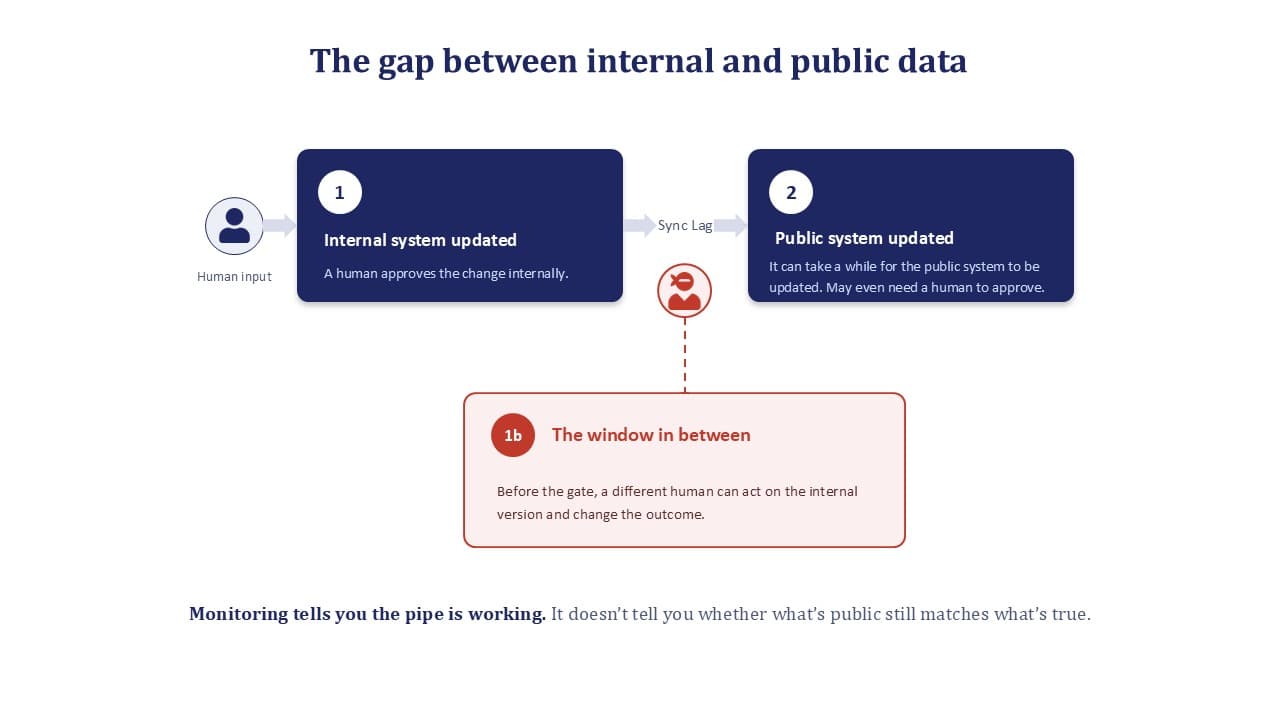
A few months back, when looking for a new place to rent, I automated a search I was doing. Claude cowork helped me create a script that ran at logon, curl-ed a few URLs and alerted me when there was a favourable result. Eventually, on advice from some people who had been through the system, I drove down to one of the community offices and asked them in person. They offered a specific unit that had come online on their internal system that morning, which I had the option to view and confirm within 2 hours. The unit already had at least two other potential customers looking at it offline, meaning it was never going to see the public-facing light.
This wasn't a full-fledged agent, only a script that skimmed their public pages. But it revealed that their internal system had an additional gate before things went to the public-facing system. The sync wasn't just slow, but it also faced a human process that could still change the data before the sync. All automated broker systems, as well as end customers, were meant to look at those public pages, which were outdated.
Sinch released a study about 'The AI Production Paradox'. In the press release, their CMO Sophie Cheng said, "For years, the AI conversation has largely focused on whether organizations can get AI into production. Our research suggests another challenge is emerging: making sure leadership and operational teams are working from the same reality."
Sinch's research found 62% of enterprises already have agents live in production. Agents, both internal and external, are only as reliable as the data they're seeing, and most systems were designed for humans to eyeball, correct and approve. On one hand, human-in-the-loop is the right approach when the data has been created by an agent. But once a human action has created / approved the data, it needs to flow downstream to all consumer systems uninterrupted, for agents & scripts to trust.
As more and more of the work goes to agents, having the data online being correct has become more important than whether the automation works. Of the production agents in those 62% organisations, I'd guess most would have a version of this gap and not know it yet. You've been putting in DevOps monitoring for whether things are running smoothly, and used DataOps only for pipeline reliability. It's time to have DataOps monitor whether the data accessible by scripts and agents is consistent, especially all that is public.
Sinch report: https://sinch.com/ai-production-paradox/
Press release: https://www.group.sinch.com/media/press-releases-and-news/2026/sinch-research-60-of-executives-are-confident-their-ai-programs-are-succeeding-only-43-of-the-teams-delivering-them-agree/
#AIAdoption #DataOps #AITransformation